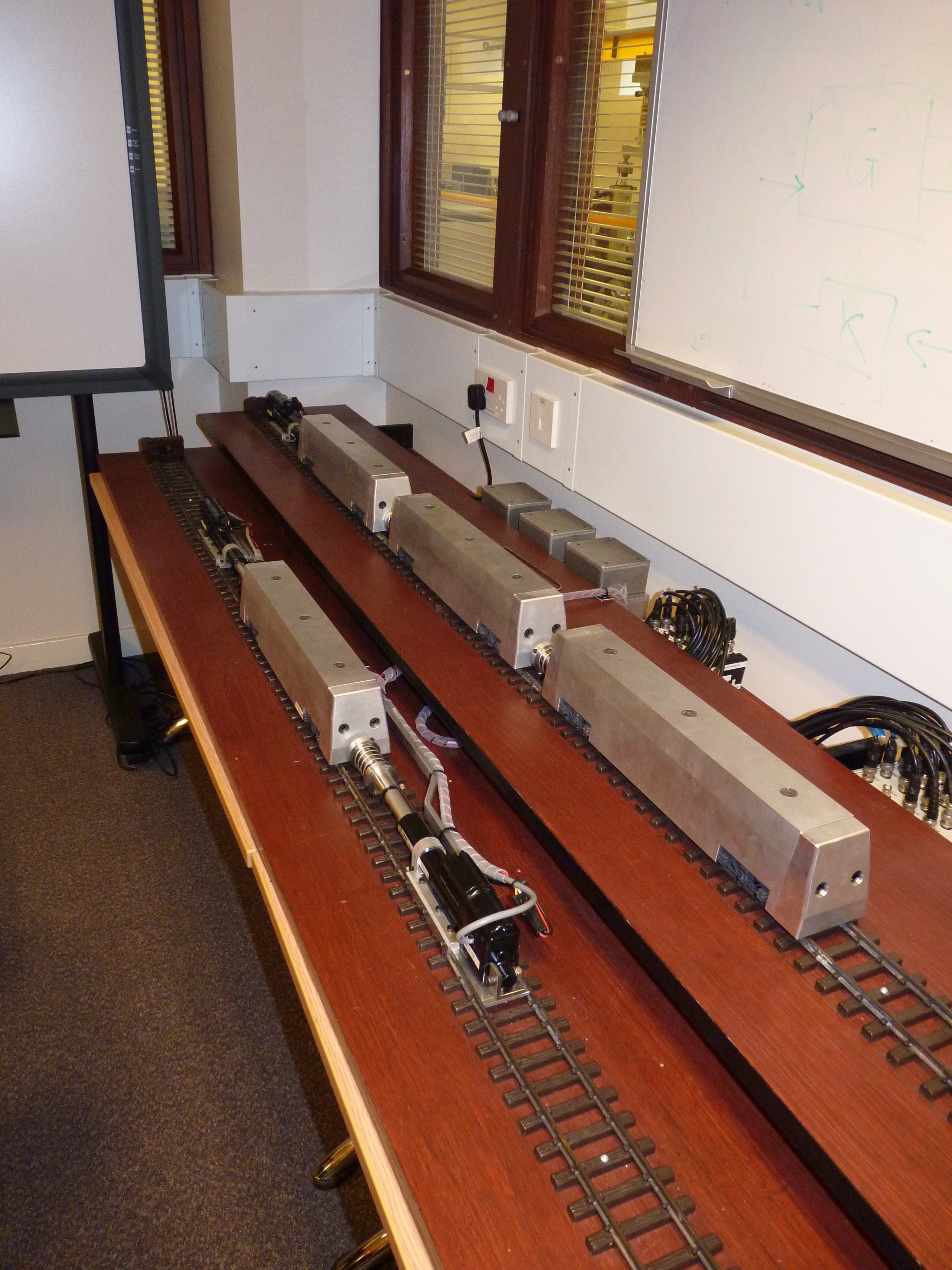
Dynamically substructured system (DSS) is used for dynamics testings. A DSS contains both numerical and physical components, which aims to provide a more realistic, real-time testing approach for dynamic systems than hitherto been possible. It enables full-size, critical components of a complete system to be physically tested in real-time, within a laboratory environment, whilst the remainder of the system is modelled numerically.
The reasons for using this hybrid testing method can arise from two situations:
The applications of DSS testing can be found in various fields including civil engineering, aerospace and automotive, etc. Some examples are:
The performance of a DSS is evaluated by assessing if the difference between responses of the DSS and the target emulated system is small enough. This is usually hard to be assessed because the emulated system is assumed to be unavialable. However, this difference is reflected by the sychronization error of the interface signals between the numerical and physical substructures. The sychronization of the substurctures is the key control problem of a DSS and a high fidelity conroller is required to cope with the uncertainties and nonlinearties within the physical substructure. The control of a DSS can be viewed as a regulation problem measured disturbance rejection. Here the testing signal is viewed as the measured disturbance; the sychronization error is viewed as the output; some acutators attached to the physical substructure are used to provide input signals.
back to top