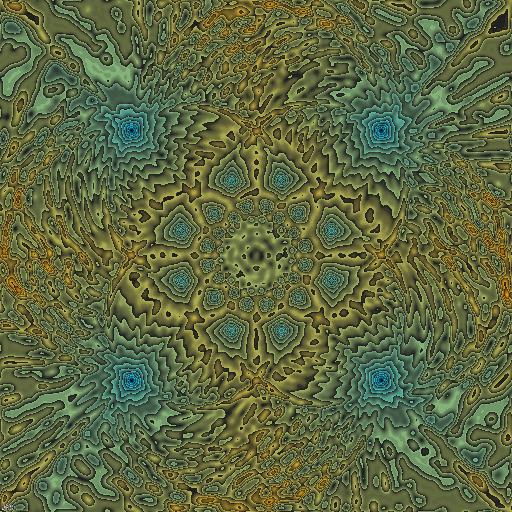
artistic view of the prime numbers.
artistic view of the prime numbers.
                    5 --- 4 --- 3

                    |           |
                    |           |
                                      .
                    6     1 --- 2     .
                                      .
                    |                 |
                    |                 |

                    7 --- 8 --- 9 --- 10
                    d(N) = number of divisors of N, thus
                    d(N) = 2 if N is a prime number (including N=1 for the sake of simplicity),
and : f(x) = an arbitrary function, for example,
f(x) = x
Thus a first
interesting picture P1 is obtained with many linear structures made of
points of the same color. For example, when chosing : f(2) = whiteand :
f(d) = black \-/ d#2the picture displays all the prime numbers till the number of points of the picture (in this case 512x512 = 262144). Then, it is known as the Ulam spiral.
                           1
                    z --> ---
                           z
the picture plane being the Complex Plane.