
| Functional brain image analysis |
|
|
|
|
| RME Home |
| DCS Home |
| Research |
| Teaching |
| Publications |
| Contact |
|
|
| Email me |
Alex Schmolck and Richard Everson
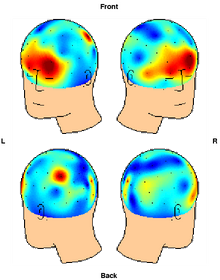
A topological reconstruction of an EEG artifact.
If psychology is all about studying minds then brains are all about creating minds and in this light the massive boom in neuro-scientific research brought about by technological developments (such as fMRI and MEG) that finally allow researchers to non-invasively study the live human (and animal) brain during psychological experiments is unsurprising.
But brains not only create minds, but also various kinds of physiological artifacts (on top of which each form of brain imaging device adds its own distortions and omissions) and the scientific analysis and interpretation of functional brain imaging data remains fraught with difficulty. A measure of the relative infancy of the field is the fact that many of the most widely used techniques (SPM for fMRI, regression, averaging and PCA for EEG/ERP) owe their existence more to the ready availability of standard statistical techniques than to the analysis requirements of data of this magnitude and nature (as an example: a temporal or spatial re-shuffling of the data followed by an inverse shuffle of the analysis results will typically yield the same answer as just analysing the unmodified data -- in other words the spatial and temporal coherence of brain imaging data typically remains unutilized; this still holds true even for more recent techniques such as ICA).
Consequently this research focuses on leveraging prior knowledge such as the experimental stimulation pattern and general temporal and spatial coherence properties of brain signals to reject physiological artifact and noise contamination (which often by far exceeds the signal of interest in magnitude). This is done within a Bayesian framework which is not only theoretically "clean" but also offers practical advantages for model selection and evaluation.
Most recently this work has concentrated on exploring the use of sparse wavelet reconstructions as a means to enforce noise reduction and temporal coherence in the extraction of EEG data.