
| Multi-class receiver operating characteristics |
|
|
|
|
| RME Home |
| DCS Home |
| PASCML |
| Research |
| Teaching |
| Publications |
| Contact |
|
|
| Email me |
Jonathan Fieldsend and Richard Everson
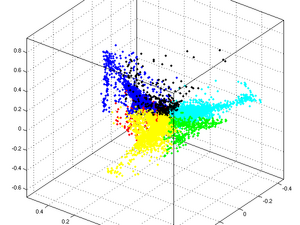
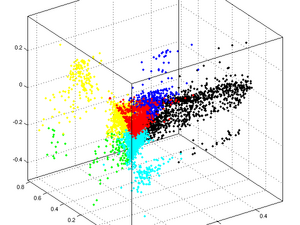
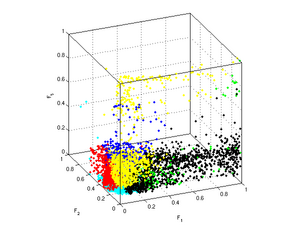
The Receiver Operating Characteristic (ROC) has become a standard tool for the analysis and comparision of classifiers when the costs of misclassification are unknown. There has been relatively little work, however, examining ROC for more than two classes. This work is concerned with extending the standard two-class ROC analysis to multi-class problems. We define the ROC surface for the Q-class problem in terms of a multi-objective optimisation problem in which the goal is to simultaneously minimise the Q(Q-1) misclassification rates, when the misclassification costs and parameters governing the classifier's behaviour are unknown. Evolutionary algorithms can be used to to locate the Pareto front---the optimal trade-off surface between misclassifications of different types. These front live in Q(Q-1)-dimensional space, and this page shows some short movies of Neuroscale visualisations in 3D of the fronts in 6D (from 3-class data). More details can be found in the technical report: Multi-class ROC analysis from a multi-objective optimisation perspective.
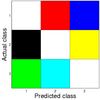
Neuroscale representations of the Pareto optimal ROC surface for synthetic
data using a k-nearest neighbour classifier or a MLP. Solutions are coloured
according to the actual and predicted classes which are most misclassified,
as shown by the coloured confusion matrix.
Click on the images to download AVI movies.
k-nearest neighbour
|
MLP
|
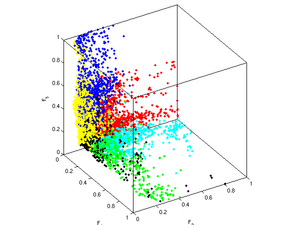
Pareto optimal ROC surface for synthetic data projected into false positive space.
k-nearest neighbour
|
MLP
|