#!/usr/bin/env python
# -*- python-mode -*-
# -*- coding: UTF-8 -*-
###########################################################################
######################## Eureka latin hexameters #########################
###########################################################################
##
## o author: Richard Everson (R.M.Everson@exeter.ac.uk)
## o created: 2011-04-14 22:08:17+00:40
## o license:
from random import choice
from string import upper, capitalize, join
drums = [
[ 'fervida', 'trucida', 'invida', 'martia', 'turpia', 'lurida', 'pessima', 'aspera',
'ignea', 'altera', 'barbara', 'impia', 'horrida', 'sontia', 'bellica' ],
[ 'tela', 'nota', 'castra', 'signa', 'regna', 'jura', 'facta', 'templa', 'ferra',
'damna', 'verba', 'froena', 'vincla', 'sacra', 'pila', 'sponsa' ],
[ 'foris', 'suis', 'sequa', 'puto', 'feris', 'patet', 'fere', 'reis', 'bonis',
'modis', 'palam', 'domi', 'quidem', 'malis', 'cito', 'tuis' ],
[ 'promulgant', 'depromunt', 'portendunt', 'confirmant', 'praemonstrant', 'conjungant',
'progignunt', 'decidunt', 'proritant', 'praenarrant', 'producunt', 'declarant',
'conquirant', 'monstrabunt', 'profundunt', 'corradunt', 'promittunt', 'casuabunt' ],
[ 'vulnera', 'nomina', 'munera', 'tristia', 'tempora', 'agmina', 'crimina', 'lumina',
'prelia', 'carmina', 'vincula', 'spicula', 'nubila', 'verbera', 'foedera', 'jurgia',
'fulgura', 'somina', 'organa' ],
['saeva', 'senta', 'cara', 'firma', 'dira', 'moesta', 'torva', 'mira', 'mala',
'nigra', 'rara', 'multa', 'letha', 'quaedam', 'nequam', 'dura', 'densa', 'crebra',
'fursca', 'prava' ]
]
h = " ".join([ choice(drum) for drum in drums ]).upper().capitalize()
print """Content-Type: text/html
Eureka: John Clark's Latin Hexameters
Eureka: John Clark's Latin Hexameters
|
%s
|
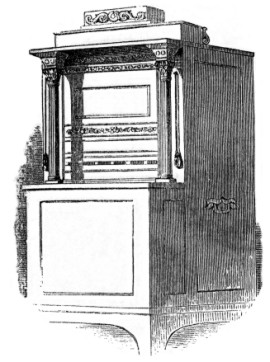
This is a randomly generated latin hexameter generated using the component words from John Clark's Eureka machine built completed in 1845. There are over 26 million possible hexameters.
Reload the page to get another one.
|
|
|
""" % h
print """
The vocabulary of words is taken from those listed by D.W. Blandford in
his article The 'Eureka'
(Greece and Rome, Second Series, Vol 10, No. 1, March 1963, pp
71-78). No attempt has been made to remedy the errors Blandford points out:
"three words (trucida, sequa,
casuabunt) are non-existent, three (puto, cito, mala) have false quantities,
two (nota, tristia) are in the wrong column, one (somina = somnia) is
misspelt, one (foris) is repeated, and at least one other (letha) has
something wrong."
"""