Dynamical Systems and Ergodic Theory
Basic ideas. Given a discrete time map f:X-> X, of a space X into itself, and preserving a measure m (so that m(f-1}A)=m(A) for all subsets A &sub X) ergodic theory provides a mechanism of understanding the limiting behaviour of the time averages:
Simple examples of ergodic systems. The coin tossing map (or Bernoulli map) f:[0,1]->[0,1] given by f(x)=2x (mod 1) is ergodic and the invariant measure is Lebesgue measure. Another example is an irrational rotation of the circle, i.e the map r:[0,1]->[0,1] given by r(x)=x+&alpha (mod 1), with &alpha an irrational number.
Mixing ergodic systems. A mixing dynamical system is one for which future observations performed on the system are (asymptotically) independent of those performed in the past. Formally we say (f,X,m) is a mixing system if
Statistical properties of Lorenz attractors.
The classical Lorenz for parameters &sigma=10, &beta=8/3 and &rho=28 are given by:dx/dt = &sigma (y-x)
dy/dt = &rho x - y - xz
dz/dt = xy - &beta z.
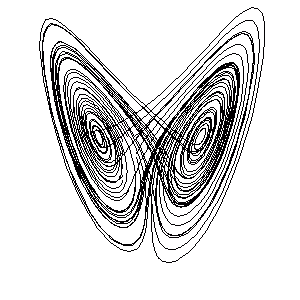
The Lorenz strange attractor
Ergodic theory of strange attractors.
The Hénon map f:(x,y)->(a-x2+y, bx) with classical parameters a=1.3 and b=0.4 was studied first in 1974 by astronomer M. Hénon. For these parameters it is still an open problem to decide whether the observed attractor is genuinely strange or whether it is just some high period attractor.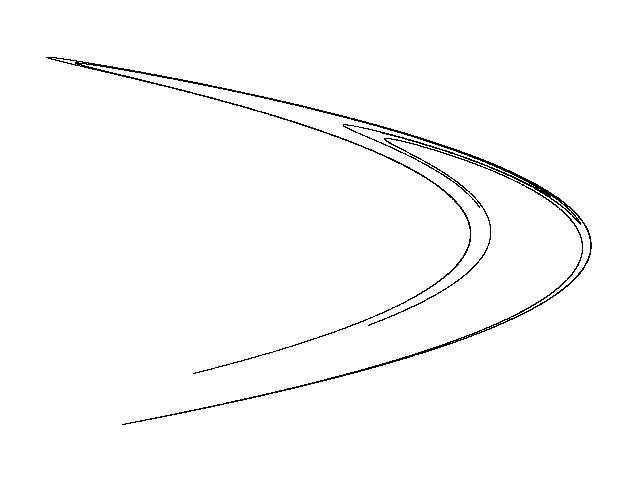
The Hénon strange attractor